
Finding South Laurel Residents
Every lookup starts with the right question. An address fits a parcel card, a deed reference, a map query, or a permit trail. A full name with identifying details suits a court index or a voter-registration match. Older dates and faded street spellings point to the library and archives. No single record proves everything about a household. A parcel identifies an owner of record, while a dated directory volume can identify a past listed household. Keep those two findings labeled separately.
South Laurel is an unincorporated census-designated place in Prince George's County, so it has no city clerk or municipal court. County and statewide custodians hold most of the trail. A Laurel mailing label aids postal and historical searches. That label never turns an address into a City of Laurel record. Search narrowly and keep every record number. Compare only what a source shows.
- For a property address, search the county parcel record and save its account, situs address, mailing address, and deed reference.
- Use the deed reference in the land-record index to identify the parties, instrument, recording date, and prior reference.
- Open the parcel in the county map tools when a boundary, adjoining parcel, zoning, or association layer matters.
- Use the voter search only when the required name, birth date, and ZIP details are already known.
- For older households, move to directories, newspapers, maps, census sources, and a targeted records request.
South Laurel Postal and County Lines
South Laurel's record geography trips up careless researchers. County planning describes Subregion 1 as having no municipalities. Yet South Laurel sits beside the incorporated City of Laurel, and many nearby addresses carry Laurel as their postal city. That mailing label says nothing about jurisdiction. For permits, deeds, courts, or land records, check the parcel instead of trusting the mailing line.
The county municipal-boundary guidance sends parcel research to Map Layers, then Administrative, then Municipal Boundary. PGAtlas adds zoning, district, public-land, HOA, and civic-association context. The county property layers deepen that picture. A parcel click yields an account number. From there, carry the identifier to the right county or state record, since a map is a geography tool rather than a household list.
Note: A Laurel mailing label helps postal and historical searches, but the parcel boundary controls which local custodian holds the government record.
South Laurel Resident Records Offices
Three offices anchor current records for South Laurel residents. The county Land Records Division keeps real-estate instruments. Maryland SDAT supplies the assessment lead, and the state's voter service can confirm an individual registration match. Courts and libraries add separate kinds of evidence. Each source carries its own access rule, so an online result is only the start of a careful check.
Land Records Division
14701 Governor Oden Bowie Drive
Upper Marlboro, MD 20774
301-780-2253
Maryland SDAT
Statewide real-property service
Address, account, map, and parcel routes
Online property search
Maryland Voter Services
State registration-match service
Prince George's County administration
Name, date of birth, and ZIP required
The Land Records Division supports both online and courthouse research. Its county page also describes mailed copy requests with a return address. Pickup works when none is provided. Clerk staff explain access and copy procedures. They do not perform title searches. Nor do they give legal advice. Save the parcel account and deed reference before contacting the office.
South Laurel Parcel Records First
For a South Laurel address, the Maryland SDAT Real Property Search is the best first stop. You can search by county and address. You can also search by account identifier or PAN, or by map reference. It does not search by owner name. Town, neighborhood, subdivision, and ZIP searches are absent too. Normalize the street name. Drop a direction or suffix when the official help calls for it. A failed house number leaves permitted street-only and wildcard options.
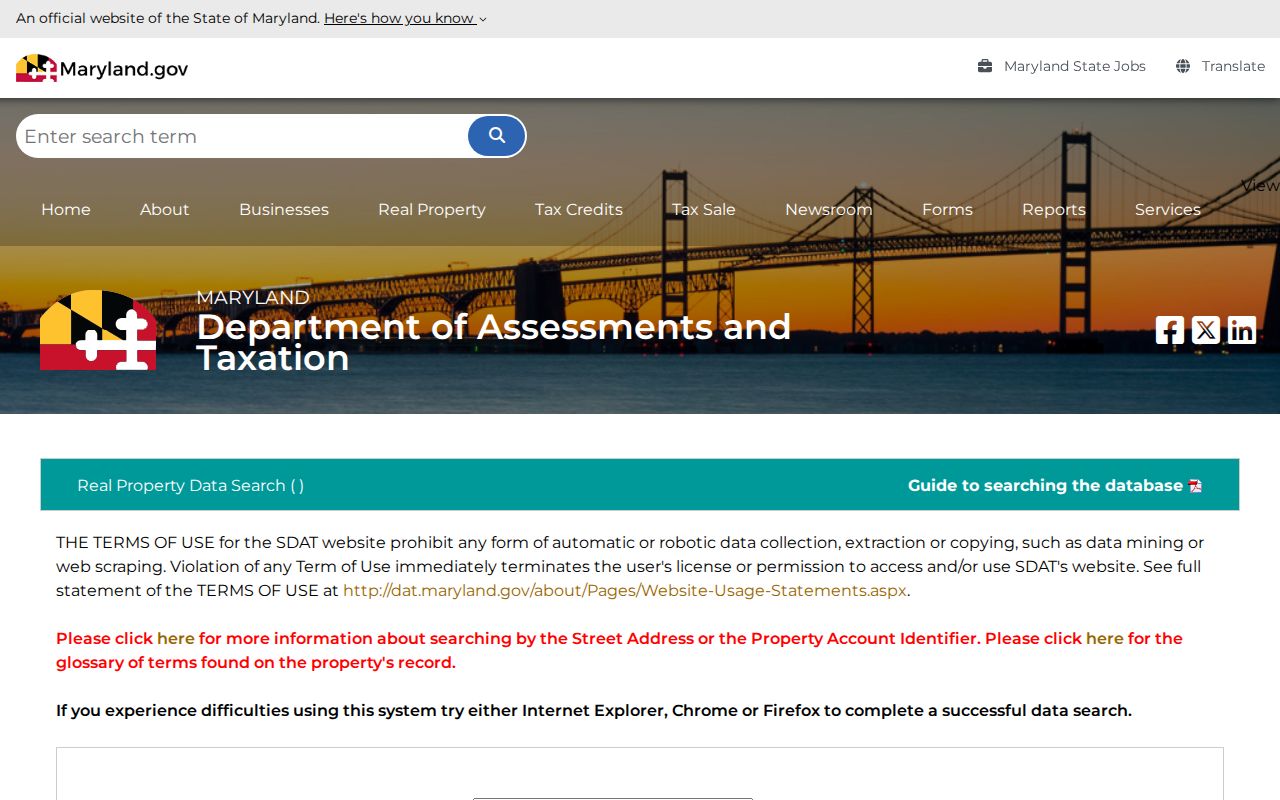
SDAT supplies a parcel lead, not a confirmed list of who lives at an address. The card can display plenty. Expect the owner field, tax-mailing address, premises or situs address, PAN, deed liber and folio, map and lot details, values, transfer information, exemptions, and principal-residence indicators. The SDAT field glossary explains each label. A mailing address reflects tax administration. It is not proof that someone lives in the household today.
- Parcel account or PAN
- A stable assessment identifier that can help connect the property card to tax, map, and permit research.
- Situs address
- The physical premises address used by the property system. It is different from the tax-mailing address.
- Liber and folio
- The book and page reference used to locate a recorded instrument in the Maryland land-record system.
- Legal description
- The land identifier in a deed, often using a plat, map, lot, block, section, or metes-and-bounds description.
South Laurel Deed and Map Trails
Carry the SDAT liber and folio into MDLandRec. Choose Prince George's County there. The book-and-page jump gets you in fast. Party and date controls help when the reference is fuzzy. MDLandRec's own guide explains grantor and grantee party types, document types, date filters, result fields, marked lists, and instrument images where they exist. One caution applies. Address searching is a Baltimore City exception. So a South Laurel street typed into an address box rarely traces a deed.
The recorded deed itself is the reward. It names who bought and who sold. It may point back to the seller's own earlier purchase. The image can also carry the legal description, execution and recording dates, and a prior-instrument reference. Electronic coverage varies by county, and Prince George's publishes no stated electronic cutoff. When the index runs dry, the clerk's historical book instructions and the Maryland State Archives series guides pick up the trail. The property chain rarely ends where the online index does.
For a spatial check, open PGAtlas or the county's ArcGIS property layers. They display a parcel's geometry and its administrative setting. The public REST service supports Find, Identify, and Query for anyone comfortable with those tools. The layers settle doubts about a postal label, a lot line, or an adjacent property. They cannot name every resident tied to a parcel.
Note: Keep the account number, legal description, deed reference, and source date together. An address alone grows weak as a key in older records.
South Laurel Voter Record Matches
Maryland Voter Services works as a match tool rather than a browsable roster. You cannot pull a list of names. The search requires a first name, a last name, and a full date of birth. It also needs a five-digit ZIP. Middle initial and street number stay optional. After a move, try the old ZIP, a former name, or alternate spellings. Small differences can break a match. The state updates the file daily. A brand-new registration may take up to three weeks to post, though. One caution belongs here. A blank result does not prove that a person never lived in South Laurel.
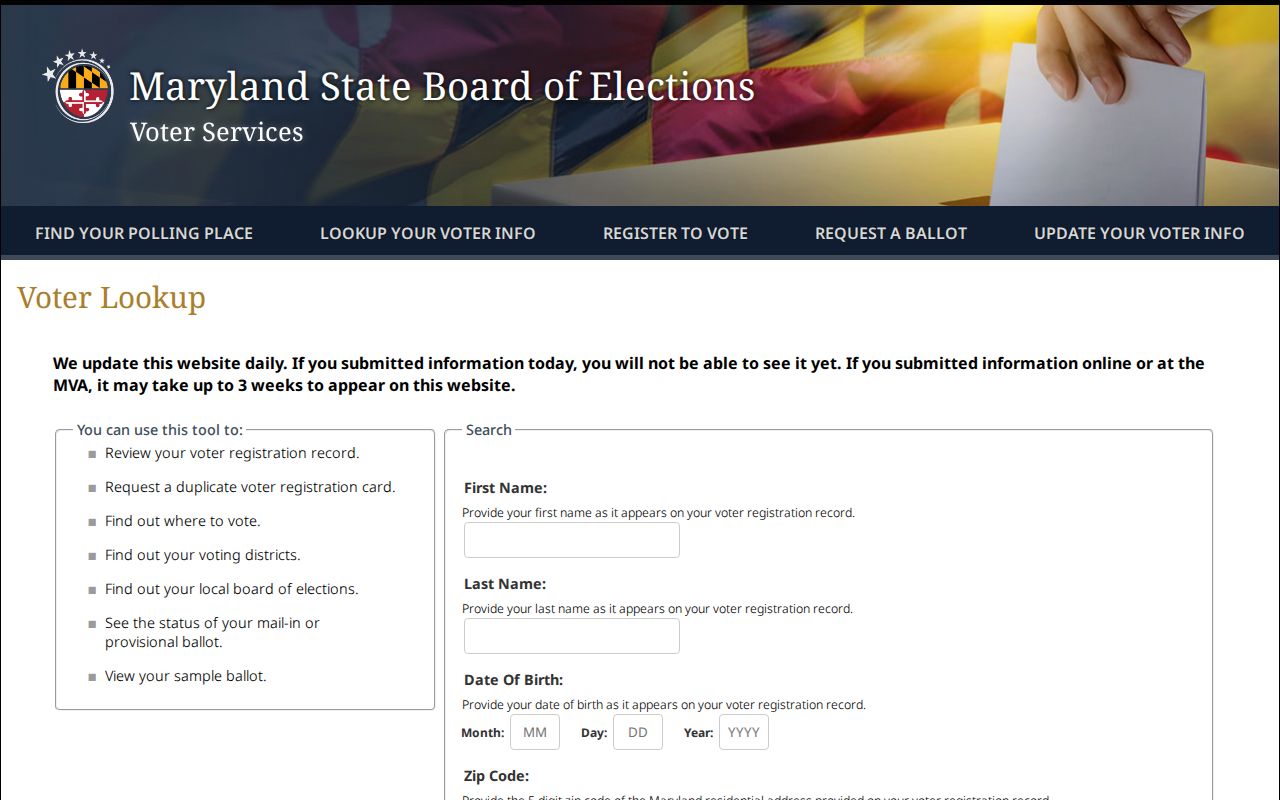
The image shows the required-match design of the official voter search. A match can open registration details. It can also open a duplicate card request, polling-place and district information, ballot status, or local-board contacts. Protected records may be withheld. The state does keep voter-file request procedures for qualified electoral purposes. The form demands a stated purpose and certification. It bars commercial solicitation, non-electoral use, and voter-behavior investigation.
| Maryland voter field | Requirement | South Laurel search note |
|---|---|---|
| First and last name | Required | Use the registration spelling and test a known variant. |
| Date of birth | Required | Enter month, day, and year. |
| ZIP | Required | A former ZIP may help after a move. |
| Middle initial / street number | Optional | Useful to distinguish same-name matches; neither creates a street roster. |
South Laurel Court Name Checks
Maryland Judiciary Case Search serves South Laurel name checks through a public case-summary model. It covers the Prince George's County Circuit Court and District Court. A result may list a case number and party names. Some addresses, hearing dates and times, document names, and a brief disposition may appear too. Start with exact names. Preserve the spelling. Reach for the portal's partial-search rule only when a full name fails. A court entry is a lead to a record. It is not identity proof or a complete history.
Full documents, older material, and some items left off the portal can require a courthouse kiosk. Some can require a clerk request. Restricted, expunged, shielded, sealed, juvenile, adoption, and other protected categories may be absent. The current portal address matters. The Judiciary issued a January 2026 postponement notice and a March 2026 launch notice. An old bookmark can misdirect a South Laurel searcher. A public summary may wait at the new address. Verify the link before relying on it for a resident lookup.
Current South Laurel Resident Directories
No single official register lists every current resident. A South Laurel residents directory is really a set of separate indexes. Each one answers a narrow question. It might cover property ownership, a voter-registration match, deed parties, a court summary, a business filing, or a professional license. Each source can support one part of a careful identification. None proves all present occupants at an address. A renter, household member, caregiver, or visitor may never appear in a property record. They simply fall outside what a property roll captures.
| South Laurel source | What it can support | Custodian | Access path |
|---|---|---|---|
| SDAT property card | Owner of record, parcel identifiers, and tax-mailing or situs data | Maryland SDAT | Address, account, or map reference search |
| Land-record index | Grantor, grantee, instrument, and title history | Land Records Division / MDLandRec | Online index, clerk, historical books, or mailed copy request |
| Voter search | A registration match and district-related information | Maryland elections system | Required identity fields and ZIP |
| Case Search | Public case summary and docket lead | Maryland Judiciary | Online summary, courthouse kiosk, or clerk copy request |
| Business or license record | Public filing or license affiliation | Maryland business and licensing services | Portal-specific search and record rules |
Match each question to the record that answers it. A parcel answers ownership. A deed traces title history, a voter result confirms a registration match, and a court entry opens a docket lead. When several records might describe the same person, hold on to middle initials, date ranges, legal descriptions, and the date attached to each source. A shared name alone proves nothing.
Historical South Laurel Resident Directories
Older South Laurel volumes usually file their listings under Laurel. So a historical residents directory search should start there. Ross & Fairall's Illustrated Laurel and City Directory appeared in October 1894. Polk's Laurel directory followed in 1962, and a Laurel City Directory in 1968. Those three anchors prove genuine local depth. They do not add up to an unbroken annual run. Treat the years as reference points rather than a series.
Where the copies live matters. The Maryland State Archives holds the 1962 Polk title as a digitized copy. The 1968 item sits in MSA series BRG29-10-65. A typical entry gives a name, an address or apartment, a telephone or room notation, and an occupation or employer-style line. Remember what the book is. A directory is a publisher's snapshot, not a government occupancy certification. The South Laurel city directory collections page explains the fuller shelf and how to read it.
Cross-checking makes any entry stronger. Line up a directory year against census records, newspapers, deeds, probate files, maps, or yearbooks from the same period. The federal census is open through 1950 under the 72-year rule. That is exactly why directories and local records fill later twentieth-century household gaps. Copy the printed street spelling and abbreviations exactly as the volume gives them. Do this before you carry them into a modern property search.
South Laurel Library Research Channels
Need a deeper South Laurel residents directory lead? The PGCMLS Prince George's Room is the strongest local history channel in the area. Its noncirculating collection holds historic newspapers on microfilm, Sanborn maps, and historic court proceedings. Assessment books, photographs, and genealogy journals round it out. A microfilm and microfiche reader is available on site. The room also offers consultation access, though callers should confirm current reader and appointment details before visiting. Stated hours run Monday 10-6, Tuesday and Wednesday noon-8, Thursday and Friday 10-6, Saturday 10-5, and Sunday 1-5.
PGCMLS's Discovery Suite layers on directory, census, genealogy, and news tools. Ancestry Library Edition works only at a branch. HeritageQuest opens remotely for cardholders with a library card and PIN. The Laurel Branch makes a convenient local gateway and can refer a researcher to the specialized room. The Laurel Historical Society's John Calder Brennan Library is one more route. It holds local records, yearbooks, photographs, files, and Laurel publications. Treat it as a research contact rather than a public member roster.
Note: Confirm hours, reader rules, and remote database access right before travel. Library services and licensing terms can change.
South Laurel Requests Under the PIA
An online index will not surface every public record. When one falls short, send a focused request to the agency that keeps it. Maryland's Public Information Act sits at Md. Code, General Provisions §§ 4-101 et seq. The Attorney General's PIA guidance points requesters to the custodian of the record. It does not route them to one central statewide records office. Name the record type, an address or parcel identifier, the date range, and the format you want. Narrow requests are simply easier for an agency to locate and review.
Section 4-203 calls for a prompt grant or denial. It also requires an explanation of timing whenever a response runs long; the ordinary framework is 30 days. Under § 4-206, the first two hours of search and preparation are generally free. Later fees must reflect reasonable actual costs. Ask for a fee estimate or a waiver when it fits. If a denial cites an exemption, keep the response on file. Then use the PIA Ombudsman, Compliance Board, or court route laid out in the state guidance.
South Laurel Address Privacy Protections
A gap in a South Laurel residents directory is not always an error. Maryland Safe at Home serves eligible survivors. Other protected participants can join too. The program gives them a substitute address with mail forwarding. Its official program page explains that a trained assistant handles enrollment. There is no enrollment fee. Participating agencies generally must accept the substitute address. The exception is a statutory exception or approved waiver.
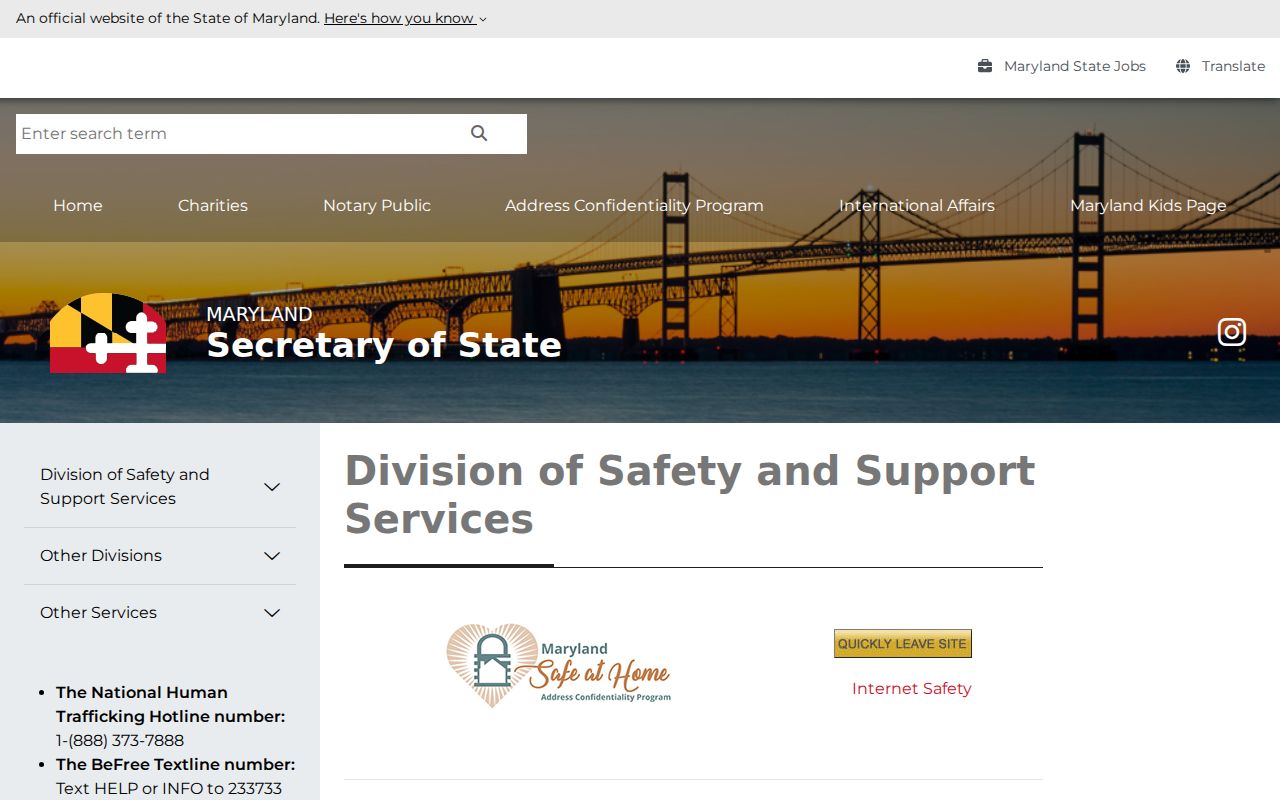
That is why a voter, court, or agency result may show no ordinary residence address. Vital records, juvenile records, sealed cases, protected voter files, and motor-vehicle data each carry separate privacy rules. The Maryland Public Information Act permits exemptions. Maryland Transportation § 12-112 limits personal information drawn from motor-vehicle records. Never try to defeat a protected address by piecing together unrelated fragments.
South Laurel Safety Registry Limits
The Maryland Sex Offender Registry is a public-safety resource with legal limits of its own. Its official search accepts a name, ZIP, and registry filters. Results may include photographs, aliases, address information, conviction or statute data, and tier-related information. It is not a general resident directory. The registry warns that entries change. Identity should be positively confirmed through reliable official means.
The registry's warning deserves as much weight as its search controls. A blank name or ZIP result never proves a person's absence. Results must not be used for harassment, intimidation, threats, or stalking. For a current detention question, one local page helps. The Prince George's County inmate-locator page is the starting point. Search instructions for it should come straight from the agency itself.
South Laurel Records Fallback Ladder
A failed web search is usually a routing problem. It rarely proves the record does not exist. South Laurel sits atop layered county and state systems, historical collections, and protected categories. Work from the narrow clue already in hand. Move toward the custodian that keeps the underlying record. The goal is to verify one limited fact. It is not to assemble a broad file about a person.
- Recheck spelling, postal city, ZIP, street normalization, and whether the parcel sits in unincorporated South Laurel or nearby Laurel.
- For land, retain the SDAT account and use MDLandRec book, page, party, document-type, or date controls.
- For a map or local boundary question, use PGAtlas or the county ArcGIS property service and inspect the identified parcel.
- For permits or code history, try the county's LookSee or legacy route, then request a defined date range through the county process.
- For historical households, ask PGCMLS, MSA, or the Laurel Historical Society for the relevant directory, newspaper, map, or assessment collection.
County land records, the courthouse kiosk, mailed copy procedures, library readers, archives, and a targeted PIA request all remain valid channels when a portal comes up short. Note what each source actually established. That discipline separates a reproducible South Laurel resident search from a guess built on unrelated results.