
South Laurel City Directory Holdings
Three directory anchors give South Laurel research real depth. They also show why a careful resident lookup cannot assume an unbroken annual series. The Maryland State Archives lists an October 1894 Ross & Fairall volume, a 1962 Polk's Laurel directory, and a 1968 Laurel title. Each one uses Laurel as its local heading. That can still serve South Laurel families, businesses, and old addresses well. Just make sure the date, the address, and the county setting all agree before you treat a listing as the same person.
| Collection | Years | Where Held | Access |
|---|---|---|---|
| Ross & Fairall's Illustrated Laurel and City Directory | October 1894 | Maryland State Archives special collections, from Laurel Historical Society | Digital copy identified by MSA |
| Polk's Laurel, Prince George's County, Maryland | 1962 | Maryland State Archives, Mezzanine call number 1076 Polk | Original; a digitized copy is also catalogued |
| Laurel City Directory | 1968 | Maryland State Archives series BRG29-10-65 | Collection record; no complete public scan located |
| Newspapers, maps, assessment books, and genealogy material | Dates vary by item | PGCMLS Prince George's Room and MSA | Consultation, microfilm, and collection-specific access |
Treat those dates as anchors, not as proof of a continuous run. No official catalog establishes that every year from 1894 through 1968 survives in print. A missing name is simply a prompt. Go back to the catalog, the newspapers, or a neighboring year. Do not conclude anyone left South Laurel before that.
South Laurel Directory Years
The timeline of surviving volumes is useful but uneven. Ross & Fairall supplies a late-nineteenth-century snapshot. Polk's offers a mid-century reference point. The 1968 Laurel title pushes the record later, though it cannot show that a matching volume was issued or preserved every year in between. Copy the catalog title exactly as printed, including Laurel, because the modern South Laurel CDP name rarely appears in older catalog language.
- 1894: the Ross & Fairall illustrated Laurel volume appears in the MSA special-collections guide.
- 1962: Polk's Laurel is listed by MSA and catalogued as a 1962 directory.
- 1968: the Laurel volume is identified in MSA series BRG29-10-65.
- After the verified anchors: use library catalogs and archive staff to locate adjacent years instead of assuming a volume exists.
That gap matters more than it looks. A city directory is a publisher's dated survey, not a county occupancy roll. Someone may appear under a spouse, a boarding address, a business, or a shortened name, and a household can be skipped in one edition while staying right in the same place. Note: Keep the publication year beside every transcription, since similar Laurel headings can represent different local geographies and survey dates.
South Laurel Directory Research at Prince George's Room
The PGCMLS Prince George's Room is the strongest county-level stop. It shines when a South Laurel historical volume hands you an address that needs context. Its noncirculating collection holds historic newspapers on microfilm and a microfilm and microfiche reader. You will also find Sanborn maps, historical court proceedings, assessment books, photographs, and genealogy journals. Hours run Monday 10–6, Tuesday and Wednesday noon–8, Thursday and Friday 10–6, Saturday 10–5, and Sunday 1–5. Confirm the schedule before you go. The Prince George's Room collection page displays the local-history access point. It supports this kind of South Laurel directory research.

Its newspapers, maps, and assessment books help you test whether a directory address marks a household, a business, or a street that later changed names. The newspapers show who lived at an address. The maps and assessment books confirm the block. A business entry may instead mark a street that later changed names. The nearby Laurel Branch works well for referrals and electronic resources. PGCMLS also offers its Discovery Suite. There, HeritageQuest reaches cardholders remotely. Ancestry Library Edition runs in the branches. Pairing census clues with directory clues works nicely there. Neither source, though, adds up to a current-residence claim on its own.
South Laurel Directory Sources for Local History
Directory research gets stronger when the printed entry sits beside local material. That material keeps names in context. The Prince George's Room gathers newspapers, court proceedings, assessment books, maps, and photographs. Genealogy journals join them in one consultation. The Laurel Historical Society's John Calder Brennan Library adds Laurel records, photographs, books, and files. Yearbooks and Laurel Leaders material supplement them. These collections serve family, school, old-house, and civic history questions well.
Neither institution works as a current public household register. The historical society publishes no member roster. Ask staff for a specific item, date range, street spelling, or organization. Avoid a broad request for a list of people. A newspaper notice or a yearbook can back a historical connection. A county record such as a deed or parcel file remains the answer to a legal ownership question.
Reading a South Laurel Directory Entry
Read each entry as a compact, dated record. Snippets from the catalogued 1962 Polk volume show name or business lines, street or apartment addresses, occupation or employer-style notation, and abbreviations such as apt, emp, lab, tchr, vacant, continued, and r. The volume's own key settles anything unclear. Preserve the notation exactly as printed, and check that key before expanding it.
| Name or business line | Copy the spelling, initials, and line order as printed. |
|---|---|
| Street or apartment address | Use it as a dated location clue, then preserve the street spelling and unit notation. |
| Occupation or employer-style text | Record the notation without treating it as proof of present circumstances. |
| Abbreviations | Transcribe symbols and shortened words, then consult the volume's key before interpreting them. |
| Business or organization entry | May provide a place name or address that can be checked in newspapers and maps. |
- Criss-cross directory
- A street-order section that can connect a historical address to the name printed beside it in that edition.
- Householder index
- An alphabetical arrangement intended to help locate a named household or head-of-household entry.
- Abbreviation key
- The publisher's legend for shortened terms and symbols. Photograph or transcribe it with the entry before making an interpretation.
A street-order section may not appear in every volume. When it does, compare the alphabetical and street sections from the same edition before jumping to another year. That one check often catches a different person sharing a surname, or a street spelling that changed between editions.
Comparing South Laurel Directory Clues
A historical directory and a modern parcel record answer different questions. The directory places a name or business at an address on the publisher's date. The Maryland SDAT Real Property Search answers the modern side. It shows the current owner of record. It also gives the property location, a mailing address, and a deed reference. Neither record alone proves continuous physical residence at the house. Keep the two apart. That keeps an old South Laurel directory listing from being read as present occupancy.
| Source | Best historical use | Key caution |
|---|---|---|
| Printed directory | Printed name, address, business, and notation for one publication date | Not a continuous series or official occupancy roll |
| SDAT parcel card | Current property, owner-of-record, mailing, and deed-reference lead | Mailing and assessment fields do not prove who lives there |
| Newspaper or yearbook | Dates, family references, school, civic, and local event context | Needs corroboration for legal ownership or a certified event |
South Laurel entries can carry a Laurel postal label even when the property record sits with Prince George's County. That mismatch trips people up. Treat the postal line as a mailing clue only, not proof of municipal jurisdiction, and let the county records settle the question.
South Laurel Directory Research in Layered Archives
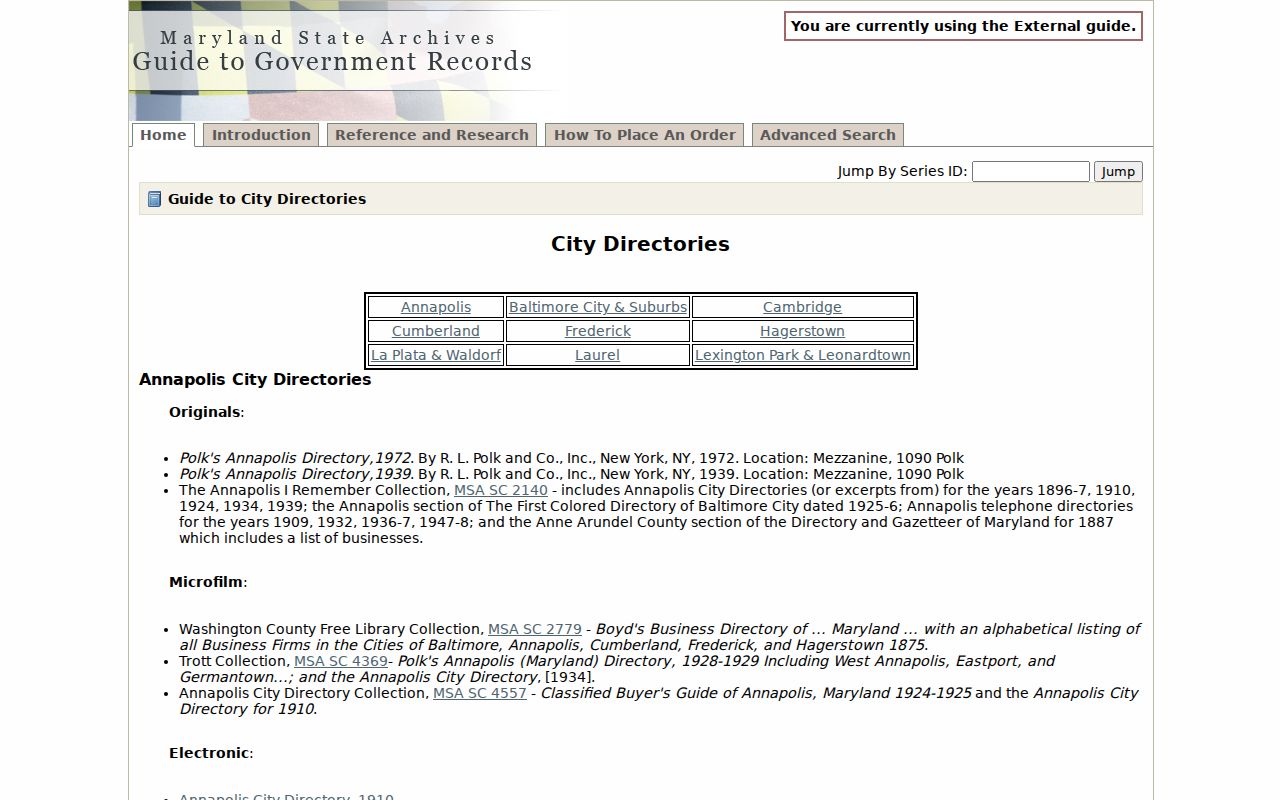
The Maryland State Archives city-directory guide is the strongest catalog route. It leads to the verified 1962 Polk holding. A separate BRG29-10 series record identifies the 1968 Laurel directory. The Archives also publishes wider guides. These cover county land, probate, court, military, naturalization, and map series. Search by collection and date. No single name search spans every historical record group. Plan on working series by series. The State Archives city-directory guide page itself lists the directory holdings and their catalog references.
Read the catalog record first. Note the title and the holding. Then confirm whether the item is a scan, a physical volume, or a collection entry requiring a staff request. If it is a collection entry, a staff request will be needed. A printed name sometimes drops out between directory years. Newspapers and the Maryland Sanborn collection can bridge the gap. The MSA newspaper guide identifies Laurel titles and their microfilm locations. Sanborn sheets show building footprints, street context, construction, and use. The Archives publishes no consolidated Laurel sheet-year list. Confirm coverage before requesting a particular map.
Tracing South Laurel Families in Directories
Family history work holds up when every entry stays tied to its year and source. Start with the earliest verified South Laurel city directory hit. Build a small timeline from there. Avoid leaping from isolated entries to modern records. PGCMLS newspapers, yearbooks, maps, and genealogy databases can test moves and family relationships. The federal census is public through 1950. It follows the standard release schedule. Later twentieth-century household gaps therefore call for directory, deed, newspaper, probate, or yearbook evidence.
- Search the name in a verified directory year and copy the page, spelling, address, and every abbreviation.
- Check the closest available directory or newspaper date for a move, a spouse or family reference, or a business change.
- Use a street-order section when present to compare the address and surrounding historical entries in the same volume.
- Pair 1894 with the 1900 census, and use the 1962 and 1968 entries with the closest available public census or local newspaper material.
- Use probate, an obituary, a deed, or a yearbook to test why the person appears, moves, or disappears from the historical record.
An entry that disappears from one volume to the next can point in many directions. The family may have moved. A name may have changed, or a death may explain the silence. Omissions happen too, and so do shifting postal descriptions and simple gaps in the collection. The directory by itself cannot settle which of these is true. So treat a vanished name as a question rather than an answer. Anyone working address-first can pair this historical shelf with the South Laurel street directory. It traces the current parcel and deed trail for the same streets.
Note: A directory entry carries the most weight when a second dated source backs up the same name, address, or family tie.
South Laurel Directory Collection Gaps
Every historical collection has gaps, and this one has several worth naming. The Laurel city-directory volumes survive only piecemeal, with no continuous run. The 1968 volume exists but has no complete public scan. Its abbreviation legend is not published separately. No full sample entry with a named South Laurel resident appears in the open record. There is also no distinct South Laurel city clerk collection to consult. South Laurel is an unincorporated community rather than a municipality. That leaves a set of practical fallbacks. The archive catalog answers one kind of question. A Prince George's Room consultation, an inquiry to the Laurel Historical Society, newspaper microfilm, and a county-record search each answer a different kind.
The discipline matters. A historical address clue, a legal property record, and a current household claim are three different things. Each lives in a different source. Local postal habits add one final trap. A South Laurel source often sits filed under Laurel, yet it remains no more a City of Laurel government record than before.